
Part of: Why Weight Loss Is Hard
Here’s a fact that surprises almost everyone: after major weight loss, the body burns fewer calories at rest than before — sometimes hundreds fewer. So you have to eat less and less just to hold steady. Researchers call this ‘metabolic adaptation,’ and it’s one of the clearest reasons kept-off weight is so hard to maintain.
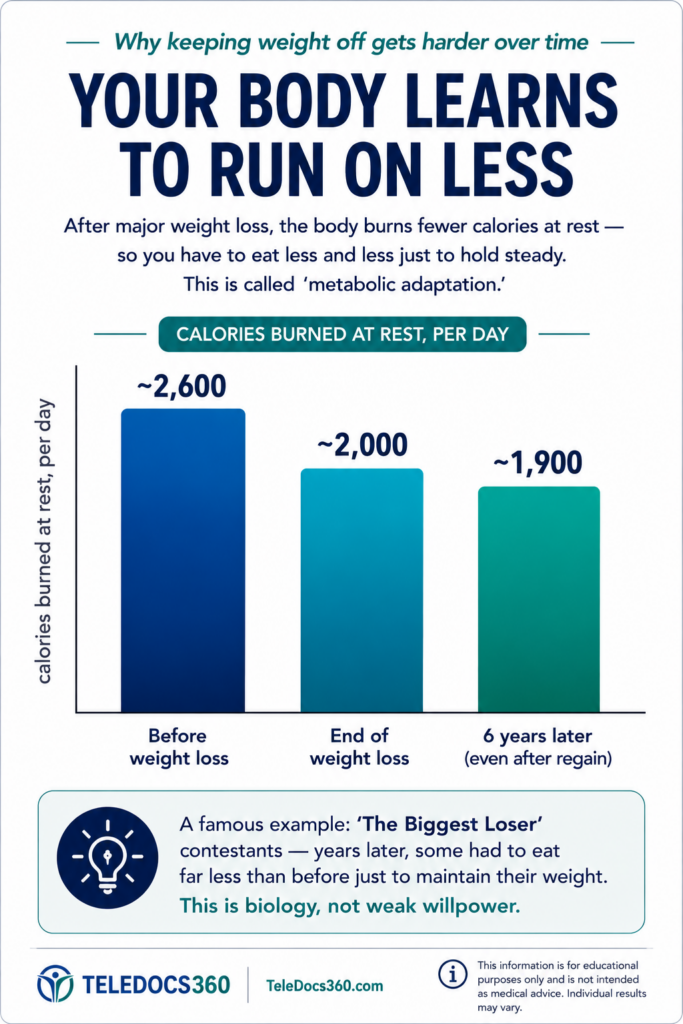
A striking example: years after a major weight-loss competition, many participants’ metabolisms were still running well below expected — not because they stopped trying, but because their biology had adapted and stayed that way. Let that sink in: if keeping weight off has felt impossibly hard, this is why — and it was never about how hard you tried. It’s exactly the kind of force medically guided care is designed to work with, and it ties directly to your body’s set point.
The science behind this

Persistent metabolic adaptation 6 years after ‘The Biggest Loser’ competition (Obesity, 2016)
PubMed summary of the same study
Share / embed this graphic
Not approved? Full refund. · Cancel anytime · no commitment.