
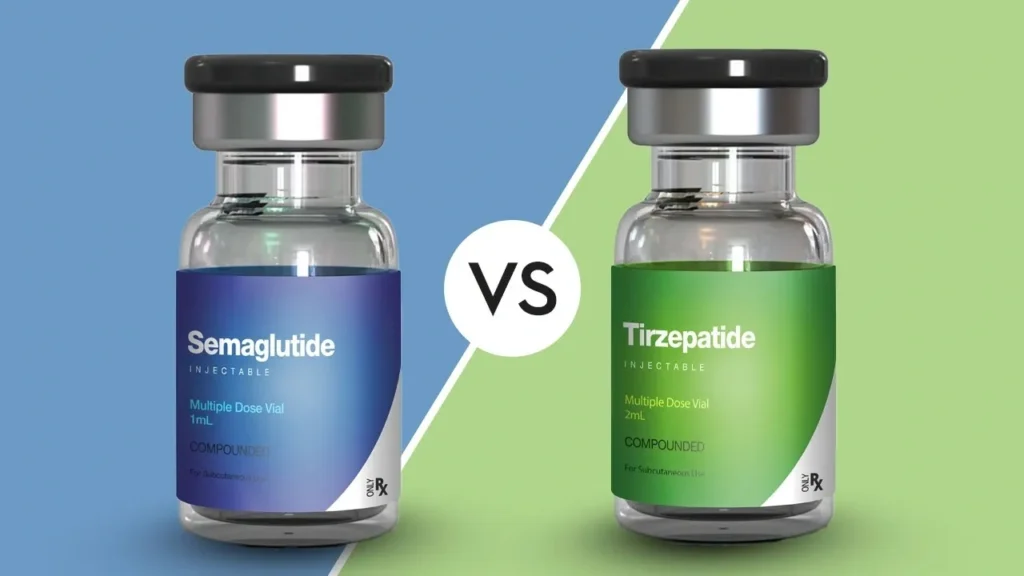
Tirzepatide vs semaglutide — if you have been searching for the best weight loss injection in 2026, these are the two names that keep coming up.
Patients comparing Mounjaro vs Ozempic and Zepbound vs Wegovy are really asking the same underlying question:
which medication actually works better, and which one is right for me?
semaglutide vs tirzepatide are FDA-approved injectable medications proven to produce significant weight loss when combined with diet and lifestyle changes.
But they are not the same drug, and the differences between them are now clearer than ever — thanks to the landmark SURMOUNT-5 head-to-head clinical trial, the first study to compare them directly in the same patient population.
This complete guide breaks down the tirzepatide vs semaglutide comparison using the latest 2026 clinical data, real costs, and side effect profiles.
What Is Semaglutide? (Ozempic® and Wegovy®)
Semaglutide was the first GLP-1 medication for obesity to gain widespread clinical use. Originally developed under the brand name Ozempic® for type 2 diabetes, it later received FDA approval as Wegovy® at a higher dose specifically for chronic weight management.
It works by mimicking the glucagon-like peptide-1 (GLP-1) hormone your gut naturally releases after eating.
Mechanism of action:
- Activates GLP-1 receptors in the brain, gut, and pancreas
- Reduces appetite and food cravings
- Slows gastric emptying — you feel full longer
- Stimulates insulin release, suppresses glucagon
- Improves blood sugar regulation
FDA-approved brand names:
- Wegovy® — 2.4mg weekly, approved for chronic weight management
- Ozempic® — approved for type 2 diabetes; commonly prescribed off-label for weight loss
Semaglutide has been in clinical use since 2017 and carries the longest real-world safety track record of any GLP-1 medication currently available. The STEP clinical trial program demonstrated consistent, meaningful weight loss across thousands of participants over multiple years.
What Is Tirzepatide? (Mounjaro® and Zepbound®)
Tirzepatide is a newer class of medication — a dual GIP and GLP-1 receptor agonist. It is the first injectable weight loss drug to simultaneously activate two separate hormonal pathways, which is why it is called a “dual incretin” medication.
Mechanism of action:
- Activates both GLP-1 receptors AND GIP (glucose-dependent insulinotropic polypeptide) receptors simultaneously
- GIP receptors in fat tissue directly regulate lipid metabolism and fat cell energy storage
- Dual activation creates a synergistic effect on appetite suppression and energy expenditure
- Produces stronger improvement in insulin sensitivity compared to GLP-1-only medications
FDA-approved brand names:
- Zepbound® — approved for chronic weight management
- Mounjaro® — approved for type 2 diabetes
Why does the dual mechanism matter? When GIP and GLP-1 receptors are activated together, the metabolic effect is additive — not simply doubled. GIP receptors in adipose tissue regulate how fat cells store and release energy. This synergistic fat metabolism effect is the primary reason tirzepatide outperforms semaglutide in every head-to-head trial conducted to date.
SURMOUNT-5: The First Direct Head-to-Head Trial
For years, comparing tirzepatide weight loss results to semaglutide weight loss results required inferring from separate trials run in different patient groups. The SURMOUNT-5 trial (published in the New England Journal of Medicine, 2024) changed that.
Trial design:
- 751 adults with obesity (BMI ≥30, or ≥27 with at least one comorbidity)
- No type 2 diabetes
- 72-week follow-up
- Tirzepatide 10mg or 15mg vs Semaglutide 2.4mg
Results at 72 weeks:
| Outcome | Tirzepatide | Semaglutide |
|---|---|---|
| Mean body weight loss | 20.2% | 13.7% |
| Achieved ≥20% weight loss | 51.6% | 31.5% |
| Achieved ≥25% weight loss | 31.6% | 16.1% |
| Relative advantage | ~47% more | — |
| Waist circumference reduction | −18.4 cm | −13.0 cm |
When looking at tirzepatide weight loss results from SURMOUNT-5 alongside semaglutide weight loss results from the STEP trials, the gap is consistent and statistically significant across every subgroup — sex, age, baseline BMI, and presence of metabolic comorbidities.
Importantly, both drugs produced clinically meaningful outcomes. A patient losing 13.7% of body weight on semaglutide has achieved a significant, health-improving result. The data does not suggest semaglutide is ineffective — only that tirzepatide delivers more.
This is the most comprehensive tirzepatide vs semaglutide head-to-head data available to date.
Real-World Data: What Happens Outside Clinical Trials
Clinical trials reflect ideal conditions. Real-world results are somewhat lower for both medications — but the advantage for tirzepatide holds in practice, not just in studies.
According to the SURMOUNT-5 trial published in NEJM, tirzepatide produced 20.2% weight loss versus 13.7% for semaglutide.
A 2026 retrospective study of US patients found tirzepatide produced 11.2% weight loss at 6 months versus 8.8% for semaglutide. In another real-world analysis of 945 patients, those on tirzepatide lost an average of 6.6 kg versus 3.1 kg on semaglutide over six months.
For a 220 lb person, this difference translates to approximately 44 lbs lost on tirzepatide versus 26–30 lbs on semaglutide over 12 months at maximum dose.
How Much Weight Can You Lose on Tirzepatide?
In clinical trials, patients on tirzepatide 15mg lost an average of 20.2% of body weight at 72 weeks. For a 220 lb person, that is approximately 44 lbs. More than half of participants achieved at least 20% body weight loss.
Real-world results average around 11–15% depending on dosage reached, adherence, and lifestyle factors during treatment. Individual response varies — genetics, baseline metabolic health, and how well GI side effects are tolerated all influence final outcomes.
Semaglutide vs Tirzepatide: Side Effects Compared
Both medications share a class-effect side effect profile. The most common issues are gastrointestinal, concentrated during the dose escalation phase and typically improving after 4–8 weeks at a stable dose.
Both medications carry FDA safety guidelines — full prescribing information is available at FDA.gov.
| Side Effect | Tirzepatide | Semaglutide |
|---|---|---|
| Nausea | ~40% | ~44% |
| Diarrhea | ~23% | ~30% |
| Vomiting | ~13% | ~24% |
| Constipation | ~18% | ~24% |
| Stopped due to GI | ~4% | ~5% |
Neither medication is significantly harder to tolerate than the other. Most side effects resolve on their own after reaching a stable maintenance dose.
Serious but rare risks (both medications):
- Pancreatitis
- Gallbladder disease
- Acute kidney injury (in severe dehydration cases)
- Black box warning: Both carry a thyroid C-cell tumor warning based on rodent studies. Neither should be used by anyone with a personal or family history of medullary thyroid carcinoma or MEN2 syndrome.
Always discuss your complete medical history with a licensed provider before starting either medication.
Tirzepatide vs Semaglutide Cost in 2026: What You’ll Actually Pay
Cost is one of the most significant practical factors — especially for patients using telehealth weight loss programs without insurance coverage.
| Medication | Who It’s For | Monthly Cost (2026) |
|---|---|---|
| Wegovy® (semaglutide 2.4mg) | Weight loss | ~$1,350 |
| Ozempic® (semaglutide 1–2mg) | Diabetes | ~$900 |
| Zepbound® (tirzepatide) | Weight loss | ~$1,060 |
| Mounjaro® (tirzepatide) | Diabetes | ~$1,020 |
| Compounded semaglutide | Telehealth | $99–$269 |
Important 2026 update: Compounded tirzepatide availability has significantly decreased after the FDA resolved the tirzepatide shortage. Compounded semaglutide remains widely accessible through licensed telehealth providers, making it the most affordable GLP-1 option for cash-pay patients right now.
If cost is your primary concern, working with a licensed telehealth provider can offer transparent pricing and medically supervised treatment plans. Learn more about our semaglutide weight loss program and tirzepatide weight loss program.
When it comes to tirzepatide vs semaglutide cost, semaglutide remains the more affordable option for cash-pay patients in 2026.
Dosing Schedule: How Each Medication Is Used
Both are once-weekly subcutaneous injections. Both use a gradual escalation schedule to minimize side effects.
Semaglutide (Wegovy®) dose ladder: 0.25mg → 0.5mg → 1mg → 1.7mg → 2.4mg (maintenance) — escalating every 4 weeks
Tirzepatide (Zepbound®/Mounjaro®) dose ladder: 2.5mg → 5mg → 7.5mg → 10mg → 12.5mg → 15mg (maintenance) — escalating every 4 weeks
Tirzepatide’s longer escalation path means it may take patients slightly longer to reach full therapeutic effect, but this also allows more time for GI side effects to settle.
Who Should Choose Semaglutide?
Semaglutide may be the better option if:
- Cost is the primary concern — compounded semaglutide offers the most affordable path to GLP-1 therapy in 2026
- You have cardiovascular disease — the SELECT trial demonstrated significant reduction in major cardiovascular events with semaglutide, giving it the strongest CV evidence base of any GLP-1 medication. These semaglutide cardiovascular benefits are particularly relevant for high-risk patients
- Your goal is 10–15% body weight loss — semaglutide reliably delivers this range for most patients
- You want the longest-established safety record — semaglutide has years more real-world data than tirzepatide
- Your insurance covers Wegovy or Ozempic — coverage landscape matters as much as efficacy
Explore our semaglutide online consultation to find out if you’re a candidate.
Who Should Choose Tirzepatide?
Tirzepatide may be the better choice if:
- Maximum weight loss is the priority — clinical data consistently shows superior outcomes at every benchmark
- You have a higher starting BMI (35+) — the absolute weight loss advantage is most meaningful at higher baseline weights
- You have insulin resistance, prediabetes, or metabolic syndrome — tirzepatide’s dual GIP/GLP-1 mechanism offers stronger glycemic and metabolic improvements than semaglutide alone, making it particularly effective tirzepatide for insulin resistance cases
- You plateaued or under-responded to semaglutide — tirzepatide frequently produces results where semaglutide stalled
- Insurance covers Zepbound or Mounjaro — when covered, the cost gap narrows significantly
Learn more about our tirzepatide weight loss program and whether you qualify.
Can You Switch from Semaglutide to Tirzepatide?
One of the most searched questions in 2026 is: “Can you switch from semaglutide to tirzepatide?” The answer is yes — and the process is more straightforward than many patients expect.
Clinical guidance for switching:
- No washout period is needed — you can transition directly without a gap in therapy
- Always restart tirzepatide at 2.5mg, regardless of your previous semaglutide dose, to manage GI side effects
- Expect possible temporary nausea during the transition as your body adjusts to the new mechanism
- Escalate every 4 weeks from 2.5mg as tolerated
- Always make this change under the supervision of a licensed provider who can monitor your response
FAQ’s
Is tirzepatide stronger than semaglutide for weight loss?
How much weight can you lose on tirzepatide?
Is Mounjaro the same as tirzepatide?
Is Wegovy the same as semaglutide?
Can you take tirzepatide and semaglutide together?
Which has fewer side effects — tirzepatide or semaglutide?
Which is better for PCOS — tirzepatide or semaglutide?
How long do you stay on these medications?
Can you get semaglutide or tirzepatide through telehealth?
Tirzepatide vs Semaglutide: Final Verdict for 2026
By the clinical numbers, tirzepatide wins — producing roughly 47% more average weight loss than semaglutide in the first-ever direct head-to-head comparison.
But “better” is always individual. Here is how to think about it clearly:
Choose tirzepatide if: Maximum weight loss is your priority, you have insulin resistance or a high BMI, you previously plateaued on semaglutide, or your insurance covers Zepbound or Mounjaro.
Choose semaglutide if: Cost is the primary barrier, you have cardiovascular disease and need the SELECT trial CV evidence behind your treatment, or you respond well to GLP-1 therapy alone.
Whether you are researching semaglutide vs tirzepatide or comparing them the other way around, the clinical data points in one direction — tirzepatide produces greater average weight loss.
Both medications represent genuine breakthroughs in obesity treatment. The most important step is working with a licensed medical professional who can review your health profile and design a treatment plan built around your specific goals.